Sharp-tailed Sandpiper
Calidris acuminata
IUCN status Vulnerable
Flyway Population
2025: 130000
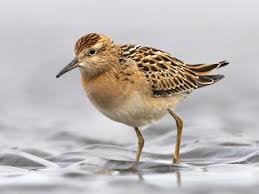
Dull rufous crown. Off-white supercilium.
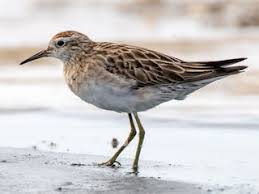
Strongly patterned feathers. Fine dark brown streaks on breast.
Bill black with paler greyish yellow brown base. Legs and feet olive-yellow.
Similar species
Most likely to be confused with very similar Pectoral Sandpiper, which overlaps in size with Sharp-tailed: females similar to or slightly smaller than Sharp-tailed; males often bigger than largest Sharp-tailed; differences useful only in direct comparison. In shape and proportions, Pectoral looks slightly slimmer (less pot-bellied) with shorter legs, longer neck and smaller head, with more rounded crown and slightly more sloping forehead. Bill slightly longer and more decurved, (often markedly so in some males, though in some bill may be short and straight or only faintly decurved). Stance more upright than Sharp-tailed. While both species stand erect with head high on upstretched neck when alarmed, Pectoral has a very different, somewhat snipe-like appearance. In non-breeding plumage, Pectoral best distinguished by differences in size and structure (above) with following characters (in rough order of importance):
- gorget: foreneck, breast and fore-flanks, off-white to buff and more uniformly and coarsely streaked black, forming somewhat darker and always more pronounced gorget, which is much more sharply demarcated from clean white belly; line of demarcation is slightly lower on underbody, is drawn into characteristic downwards point in centre, and has a distinctive spiked edge (in Sharp-tailed, gorget paler greyish-brown, more finely and sparsely streaked across foreneck, central upper breast and on sides of lower breast; lower border is more diffuse and merges into white of upper belly; and white of upper belly tends to intrude upwards onto centre of lower breast, so lower border of gorget appears gently rounded, straight or slightly concave, never with central droop of Pectoral).
- rest of underbody: white except for some messy dark streaking along flanks and, at most, a few fine dark streaks on lateral undertail-coverts (cf. vent and undertail-coverts always heavily streaked darker on Sharp-tailed).
- head and neck: slightly darker, browner and more coarsely streaked, with less contrasting pattern, and no rufous on forehead and crown (though some very worn Sharp-tailed may have rufous reduced or absent); supercilium, broader, more bulging and prominent in front of eye than behind, with usually obvious pale lateral crown-stripes often joining fore-supercilia to create split supercilium; also, supercilia and lateral crown-stripes typically leave only narrow dark central ridge on forehead, giving rather snipe-like head-pattern; dark loral stripe slightly narrower, darker and better defined; dark patch on ear-coverts less distinct; and eye-ring narrower, less prominent and contrasting.
- upperparts: darker and browner.
- bill: appears bi-coloured on most with larger paler area on basal third to half of both mandibles (on Sharp-tailed, pale base is duller grey, yellow-brown or pink, and smaller, usually confined to lower mandible).
- legs and feet: yellower and brighter, brownish yellow to orange-yellow.
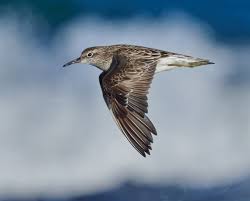
- flight-pattern: wing-bar slightly narrower and less distinct; in close views, whitish shaft of outermost primary contrasts with duller brownish shafts of rest (on Sharp-tailed, all primary-shafts uniformly pale).
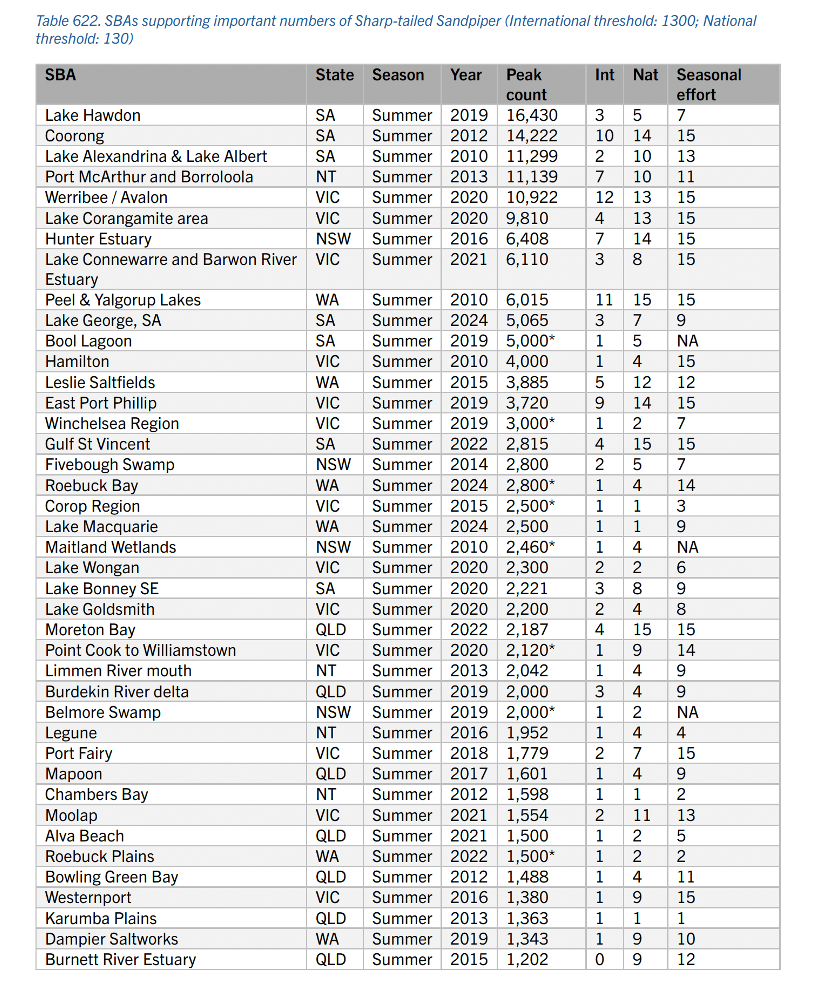
(Driessen, J., Kidd, L. R., Weller, D. R., Purnell, C., Maguire, G., Jaensch, R., and LeClair, S. M. (2025). Australian National Directory of Important Migratory Shorebird Habitat. Report for the Department of Climate Change, Energy, the Environment and Water. BirdLife Australia, Melbourne.)